Forklift Training & Certification in Dallas, Texas
Dallas forklift work runs through the southern Dallas County inland port, rail intermodal yards and air cargo warehouses. BHG trains and evaluates your operators at your facility, on the trucks they already drive.
- OSHA Classes 1–7
- Training at Your Facility
- Hands-On Evaluations
- Certification Records
Forklift Operator Training in Dallas
South of downtown, the DFW Inland Port covers more than 76,000 acres of southern Dallas County, including parts of Dallas, Lancaster and Wilmer, with access to Interstates 20, 35 and 45 and over 30,000 jobs. Much of that work happens inside large distribution centers, where operators run stand-up counterbalance trucks, reach trucks and order pickers in long aisles, and pallet jacks on busy dock floors. Peak season adds new hires who need to be trained and evaluated before they drive on their own.
OSHA's powered industrial truck standard, 29 CFR 1910.178(l), sets out three parts of operator training: formal instruction, practical hands-on training, and an evaluation of each operator in the workplace. In a Dallas distribution center, that workplace evaluation should cover your racking heights, your pedestrian walkways, your dock doors and trailer restraints, and the specific trucks on your floor, not a generic course on someone else's equipment.
BHG Forklift Training is a service of BHG Safety Partners LLC, a Disabled Veteran-Owned company based in Hannibal, Missouri. We come to your Dallas-area facility and train on your own trucks, covering all seven OSHA truck classes. We provide the formal instruction, the practical training and the workplace evaluation, and your company certifies each operator who completes them, as the standard requires.
Where Forklifts Work in Dallas
Southern Dallas County distribution centers
The DFW Inland Port lists 110 major employers, including a 730,000-square-foot Walmart perishable distribution center in Lancaster. Grocery and perishable operations bring cooler and freezer work, where condensation on floors and cold-affected batteries change how electric trucks stop and handle.
Union Pacific Dallas Intermodal Terminal
Union Pacific opened its 360-acre Dallas Intermodal Terminal in 2005 on the west side of I-45 in Wilmer/Hutchins, designed to handle 365,000 trailers or ocean containers a year. Warehouses unloading those boxes need operators trained on container floors, dock plates and trailer creep, plus forklift traffic mixed with yard trucks.
DFW Airport air cargo
DFW Airport says it handles more than 60 percent of all air cargo in Texas and has a CEIV Pharma certified community for pharmaceutical handling. Air cargo warehouses mix electric counterbalance trucks, pallet jacks and tow tractors around ULD containers, often under time pressure and near temperature-controlled rooms.
Manufacturing in the inland port
The DFW Inland Port lists a 1.35-million-square-foot Trina Solar manufacturing facility in Wilmer. Plants that receive raw material by trailer and ship finished goods in volume need operators trained on both production-floor traffic and dock work.
What Shapes Forklift Safety in Dallas
Texas is not an OSHA-approved State Plan, so private employers in Dallas are under federal OSHA and its powered industrial truck standard, 29 CFR 1910.178.
NWS Fort Worth records show the average first 100 F day at DFW falls on July 1 and the average last on August 27, with a record 71 days of 100 F or more in 2011. Dock work in unconditioned trailers and on outdoor yards should come with heat breaks, and heat belongs in the hazard portion of operator training.
Metro Dallas warehouses straddle two OSHA area offices: Dallas, Collin, Rockwall and Kaufman counties go to the Dallas Area Office, while Tarrant, Denton and Ellis counties go to Fort Worth. Companies with sites on both sides should know which office covers each building.
Union Pacific's terminal was built to process 365,000 trailers or containers a year, and the DFW Inland Port says it reaches 93 percent of the population within 48 hours. That volume keeps docks busy, so trailer restraints, wheel chocks and dock plates should be part of every evaluation.
Forklift Classes Dallas Employers Need Most
All forklift classes- Class I: Electric Rider Forklift TrainingDesigned for electric rider forklifts used in warehouses and distribution centers.
- Class II: Narrow Aisle Forklift TrainingTraining for narrow aisle lift trucks used in tight warehouse layouts.
- Class III: Electric Pallet Jack & Walkie TrainingCertification for electric pallet jacks and walk behind lift equipment.
- Class VI: Tow Tractor & Pulling System TrainingTraining for tow tractors and powered pulling equipment systems.
Dallas Forklift Training Questions
We get a lot of the same great questions from new clients. Here are the answers to the ones we hear most often — if yours isn't listed, don't hesitate to reach out directly.
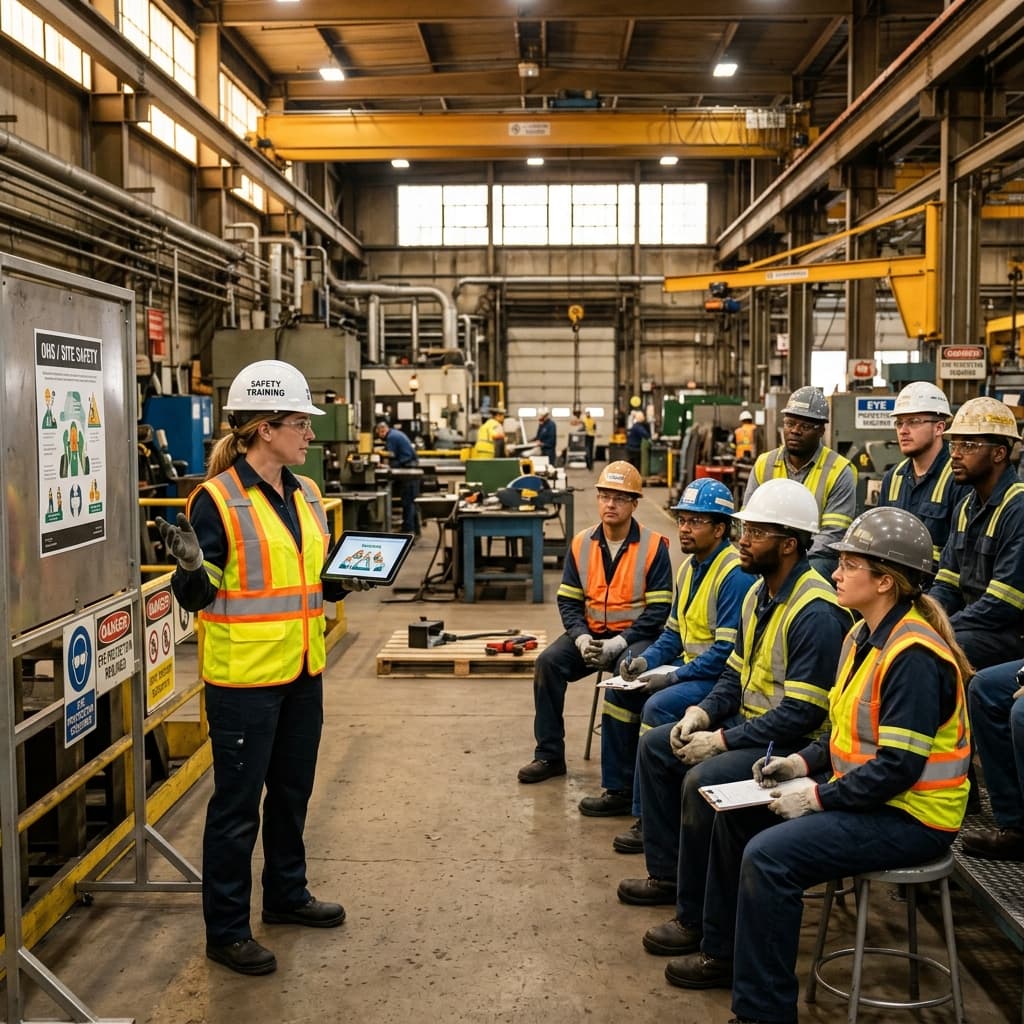
Onsite Forklift Training Session
Your Safety. Our Mission.
BHG Forklift Training trains and evaluates forklift operators at your facility, on your own trucks. Our instructors bring decades of hands-on experience in warehouses, distribution centers, manufacturing plants and construction sites.
Our approach is simple: we listen first. Every facility has its own trucks, layout and traffic patterns. We build each session around your equipment, your aisles and docks, and your shifts — so your operators train for the work they actually do.
From Class 1 electric riders in the warehouse to Class 7 rough terrain forklifts on the job site, we cover every OSHA truck class, from our base in Hannibal, Missouri to employers across 17 states in the Midwest and South, in English or Spanish.
Get in Contact with us Here!
Fill out the form below and we'll be in touch within one business day.