Forklift Training & Certification in Kansas City, Missouri
Forklift operator training and evaluations for Kansas City's underground warehouses, auto plant suppliers and distribution centers, delivered at your facility on the trucks your crews use.
- OSHA Classes 1–7
- Training at Your Facility
- Hands-On Evaluations
- Certification Records
Forklift Operator Training in Kansas City
Kansas City has forklift work you will not find in many other cities: warehouses inside a mined-out limestone bluff. Hunt Midwest's SubTropolis has 10 million square feet developed underground, serving food and beverage, pharmaceutical and automotive companies among the 25-foot square rock pillars left by room-and-pillar mining. Operators there deal with blind corners at every pillar, fixed clearances and an enclosed space where engine exhaust has to be managed.
On the surface, Ford's Kansas City Assembly Plant in Claycomo builds the F-150, Transit and E-Transit with 9,205 employees, the kind of line that depends on a steady flow of parts moved by forklift and tugger. Across the state line in Edgerton, Kansas, the BNSF-served Logistics Park Kansas City has more than 15.5 million square feet of distribution buildings, where counterbalance trucks and pallet jacks shuttle loads between trailers, rail cars and racking.
BHG Forklift Training travels from Hannibal, Missouri to your Kansas City facility. We provide the formal instruction, hands-on practice and workplace evaluation that 29 CFR 1910.178(l) requires, on your own trucks and in your own aisles, docks or caverns, so you can certify each operator for the equipment and conditions they actually work in, whether that is a surface dock or a pillar-lined aisle underground.
Where Forklifts Work in Kansas City
SubTropolis underground business complex
Hunt Midwest's 14-million-square-foot former limestone mine keeps near-constant temperature and humidity, and its listed buildings offer clear heights of roughly 14 to 17 feet. The 25-foot square pillars block sightlines at every intersection, and any propane or gas truck adds exhaust to an enclosed space, so pedestrian rules, horn use and truck selection all matter in training.
Ford Kansas City Assembly Plant and its suppliers
Ford lists 9,205 employees and 1,269 acres at the Claycomo plant, which builds the F-150, Transit and E-Transit. Feeding an assembly line of that size means tuggers pulling trains of parts carts, sit-down trucks feeding the line, and constant crossing with pedestrian aisles.
Logistics Park Kansas City, Edgerton, Kansas
This 2,352-acre BNSF-served park has more than 15.5 million square feet of distribution space and 2.3 million square feet of rail-served buildings. Trailer and rail car loading brings dock-edge, trailer-creep and dock plate hazards, plus yard work on pneumatic-tire trucks.
What Shapes Forklift Safety in Kansas City
The metro straddles two states and two OSHA area offices. A company with a warehouse in Kansas City, Missouri and another in Edgerton or Kansas City, Kansas answers to the Kansas City Area Office for one site and the Wichita Area Office for the other, though both enforce the same federal forklift standard.
NWS Kansas City normals (1991-2020) put the typical early-July high at 87 to 88 degrees and the typical early-January low near 20 degrees. Outdoor dock and yard crews see both extremes, so training should cover heat breaks in summer, and ice on dock plates, ramps and trailer floors in winter.
Underground sites such as SubTropolis hold a steady temperature year round, but they add their own conditions: fixed rock clearances, pillar-lined intersections and exhaust from any engine-powered truck in an enclosed space. Hunt Midwest quotes one tenant that chose SubTropolis for its proximity to Ford's Kansas City Assembly Plant. Operators moving between surface and underground buildings need to be evaluated in the conditions where they actually work.
Forklift Classes Kansas City Employers Need Most
All forklift classes- Class I: Electric Rider Forklift TrainingDesigned for electric rider forklifts used in warehouses and distribution centers.
- Class III: Electric Pallet Jack & Walkie TrainingCertification for electric pallet jacks and walk behind lift equipment.
- Class V: Outdoor Pneumatic Tire Forklift TrainingCertification for outdoor forklifts with pneumatic tires and engines.
- Class VI: Tow Tractor & Pulling System TrainingTraining for tow tractors and powered pulling equipment systems.
Kansas City Forklift Training Questions
We get a lot of the same great questions from new clients. Here are the answers to the ones we hear most often — if yours isn't listed, don't hesitate to reach out directly.
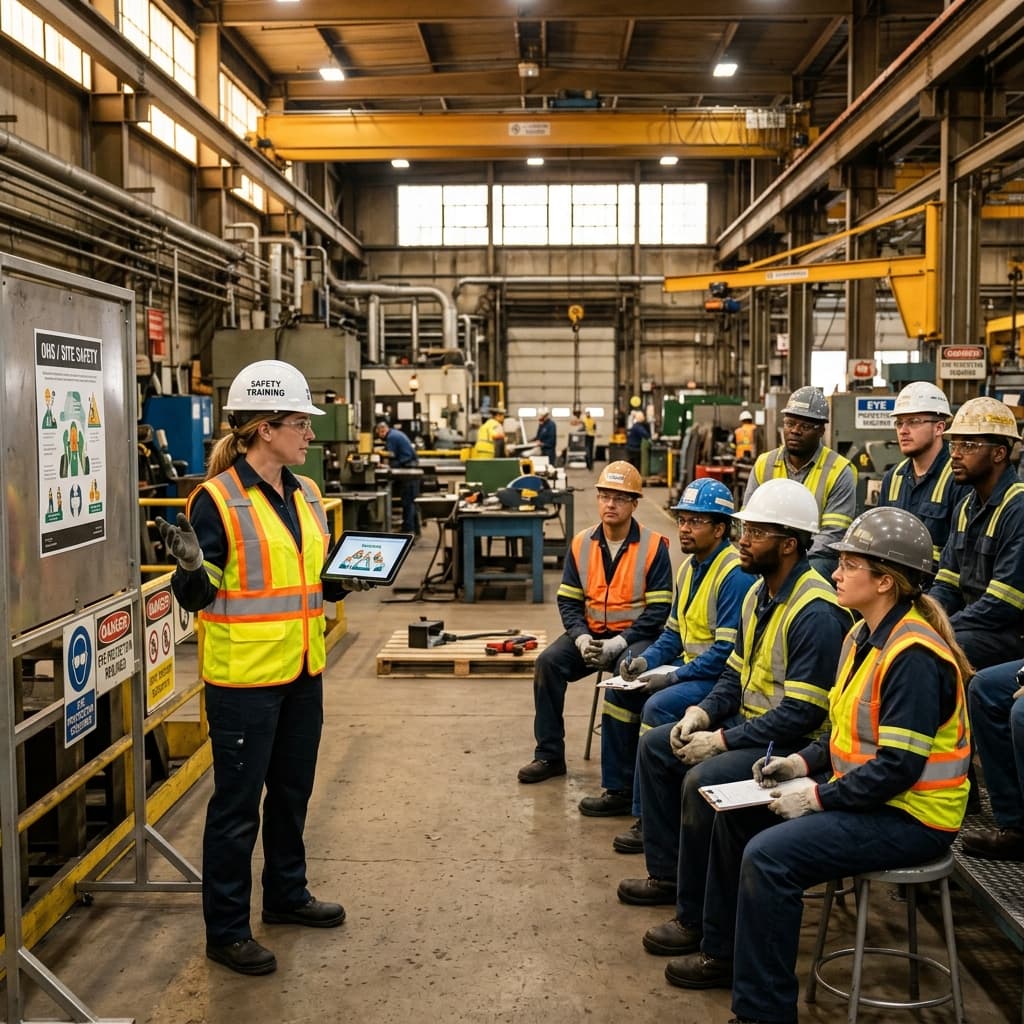
Onsite Forklift Training Session
Your Safety. Our Mission.
BHG Forklift Training trains and evaluates forklift operators at your facility, on your own trucks. Our instructors bring decades of hands-on experience in warehouses, distribution centers, manufacturing plants and construction sites.
Our approach is simple: we listen first. Every facility has its own trucks, layout and traffic patterns. We build each session around your equipment, your aisles and docks, and your shifts — so your operators train for the work they actually do.
From Class 1 electric riders in the warehouse to Class 7 rough terrain forklifts on the job site, we cover every OSHA truck class, from our base in Hannibal, Missouri to employers across 17 states in the Midwest and South, in English or Spanish.
Get in Contact with us Here!
Fill out the form below and we'll be in touch within one business day.