Forklift Training & Certification in Birmingham, Alabama
Around Birmingham, forklifts carry pipe, bar and castings out of metal plants, feed parts to suppliers for Alabama's auto assembly lines, and shuttle freight near the Norfolk Southern hub in McCalla. BHG Forklift Training comes to your plant or warehouse and trains and evaluates operators on the trucks you already run.
- OSHA Classes 1–7
- Training at Your Facility
- Hands-On Evaluations
- Certification Records
Forklift Operator Training in Birmingham
The Encyclopedia of Alabama describes how iron ore, coal, limestone and dolomite lay close together in the Birmingham District, which grew into the largest iron and steel producer in the southern United States. That history still shapes forklift work here. AMERICAN (American Cast Iron Pipe Company), founded in Birmingham in 1905, makes ductile iron pipe, spiral-welded steel pipe, valves and hydrants, and loads like those are long, heavy and easy to misjudge. Operators in metal plants deal with load centers beyond what the capacity plate assumes, rounded stock that can roll off the forks, and floors shared with overhead cranes.
Metals are only part of the picture. The Birmingham Business Alliance lists distribution and logistics, automotive, food and beverage, and advanced manufacturing among the region's key industries, and describes Birmingham as sitting where major highways, rail lines and air access meet. For forklift operators, that means high-volume docks, trailers loaded for just-in-time deliveries, and warehouses where electric sit-down trucks and pallet jacks share aisles with people on foot.
BHG Forklift Training, part of the Hannibal, Missouri-based BHG Safety Partners LLC, a Disabled Veteran-Owned company, travels to Birmingham-area sites and works on your own equipment, in English or Spanish. Your operators get classroom instruction, supervised practice and an evaluation in your building. Instruction can be scheduled around furnace outages or shift changes, and the evaluation happens on your floor, with your loads, your dock and your traffic patterns. Your company then certifies each operator.
Where Forklifts Work in Birmingham
Pipe, castings and metals plants
AMERICAN's Birmingham operation produces ductile iron pipe, spiral-welded and high-frequency-welded steel pipe, fire hydrants and valves. Handling pipe and heavy castings calls for trucks rated for the real load center, attention to capacity plates when attachments are fitted, and chocking or cradling round stock so it cannot roll.
Norfolk Southern's Birmingham Regional Intermodal Facility in McCalla
Norfolk Southern opened the $97.5 million terminal in October 2012 on a 316-acre site next to the Jefferson Metropolitan Park in McCalla, as part of its Crescent Corridor between the Gulf Coast and the Northeast. Warehouses fed by that container traffic unload trailers all day, so dock plates, wheel chocks or trailer restraints, and trailer creep belong in every operator's training.
Auto supplier plants serving Vance and Lincoln
Birmingham sits between two of Alabama's auto plants: Mercedes-Benz U.S. International in Vance, Tuscaloosa County, which began vehicle production in 1997, and Honda Manufacturing of Alabama in Lincoln, Talladega County. Supplier plants in the metro deliver parts on tight schedules, which puts forklifts and tow tractors in busy aisles next to pedestrians and line-side racks.
Distribution and food and beverage warehouses
The Birmingham Business Alliance names distribution and logistics and food and beverage as growth sectors for the region. Those buildings run electric counterbalance trucks, pallet jacks and, in taller racking, reach trucks, so operators need training on rack clearance, load stability at height and speed control around blind corners.
What Shapes Forklift Safety in Birmingham
Private employers in Birmingham fall under federal OSHA, because Alabama does not operate an OSHA-approved State Plan. The federal powered industrial truck standard, 29 CFR 1910.178, applies as written, including the operator training and evaluation rules in paragraph (l).
NOAA's 1991-2020 normals for the Birmingham airport station show an average of 65 days a year reaching 90 degrees F, with a normal July high of 91.0 F. Metal plants add radiant heat from furnaces and hot product, so operators on those floors need water, breaks and acclimatization, and heat stress is worth covering in training.
NWS Birmingham documents the EF-4 tornado of April 27, 2011, which traveled 80.68 miles from Greene County through Tuscaloosa and western Jefferson County, including the Concord and Pleasant Grove areas. Cleanup after storms like that often puts forklifts on damaged floors and in debris, so operators should be re-evaluated if conditions or trucks change.
Forklift Classes Birmingham Employers Need Most
All forklift classes- Class I: Electric Rider Forklift TrainingDesigned for electric rider forklifts used in warehouses and distribution centers.
- Class IV: Indoor Cushion Tire Forklift TrainingTraining for indoor engine powered forklifts with cushion tires.
- Class V: Outdoor Pneumatic Tire Forklift TrainingCertification for outdoor forklifts with pneumatic tires and engines.
- Class VI: Tow Tractor & Pulling System TrainingTraining for tow tractors and powered pulling equipment systems.
Birmingham Forklift Training Questions
We get a lot of the same great questions from new clients. Here are the answers to the ones we hear most often — if yours isn't listed, don't hesitate to reach out directly.
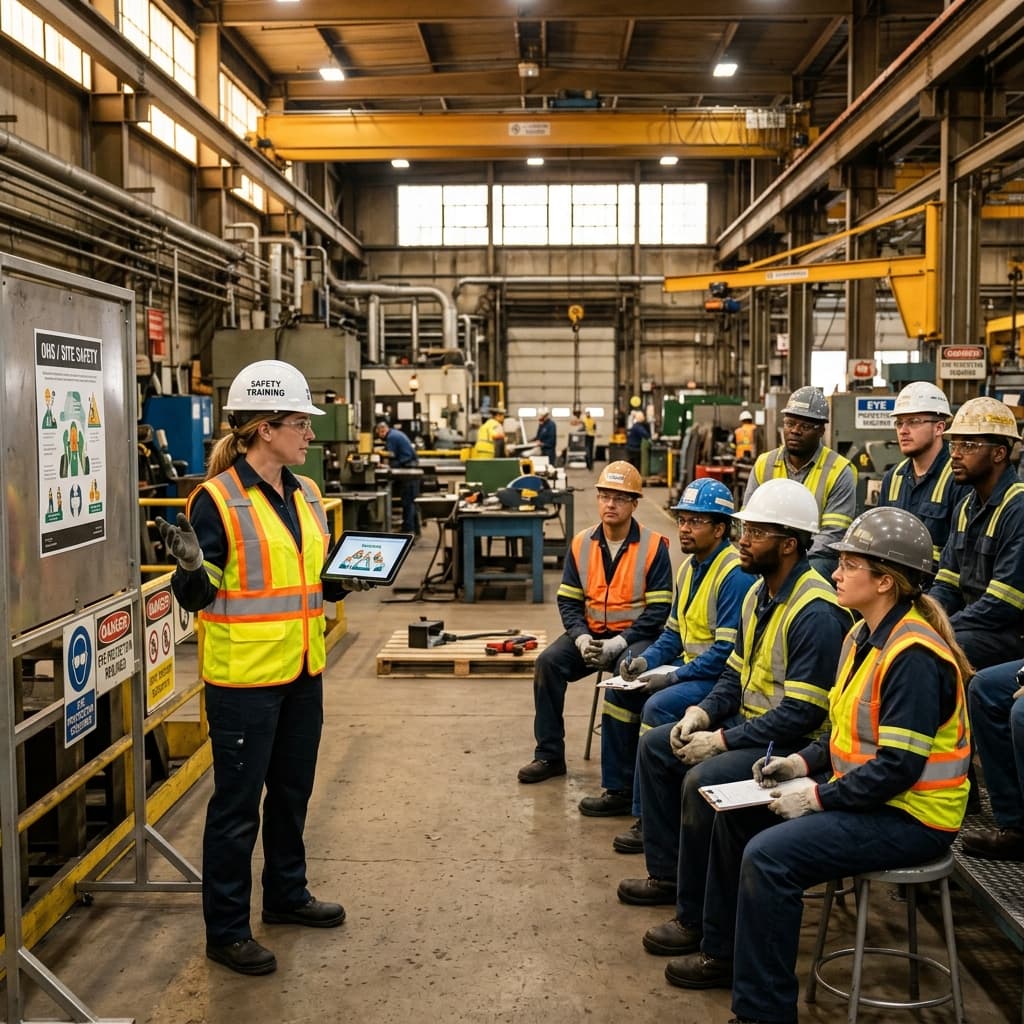
Onsite Forklift Training Session
Your Safety. Our Mission.
BHG Forklift Training trains and evaluates forklift operators at your facility, on your own trucks. Our instructors bring decades of hands-on experience in warehouses, distribution centers, manufacturing plants and construction sites.
Our approach is simple: we listen first. Every facility has its own trucks, layout and traffic patterns. We build each session around your equipment, your aisles and docks, and your shifts — so your operators train for the work they actually do.
From Class 1 electric riders in the warehouse to Class 7 rough terrain forklifts on the job site, we cover every OSHA truck class, from our base in Hannibal, Missouri to employers across 17 states in the Midwest and South, in English or Spanish.
Get in Contact with us Here!
Fill out the form below and we'll be in touch within one business day.